Twitter

Search This Blog

Showing posts with label drawing. Show all posts

Thursday, March 18, 2010

Acrylic grounds for mixed media

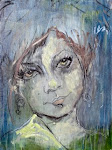
It's really easy for me to fall in love with materials. These past few years I've been dating acrylics. First, it was Tri-Art's gorgeous Artist Acrylic colours that won me over, then their innovative recycled paint Sludge...then I fell madly in love with Dry Media Ground, and now I just can't get enough of Nepheline Gels (the following artwork is graphite, charcoal and pastel on Nepheline Gel Coarse, and it's published in the New Acrylics Essential Sourcebook: Materials, Techniques, and Contemporary Applications for Today's Artist mixed media chapter). Just as I'm known for charcoal, acrylics have now become synonymous with my mixed media works, blurring the line between drawing and painting. Acrylic grounds allow me to create a textured surface that is very exciting and different than just working on common surfaces. And just like paper, I can soften dry media (graphite, charcoal, pastel) to a velvet finish with a brush, and also leave crisp edges, intense with colour or value.

Dry Media Ground is simply perfect, and will always be my true love! When you apply it to a surface, the result is like a very fine sandpaper. If you have ever used a pastel paper or board, that's what I'm talking about - it's the same thing, only it's much more cost effective to buy the Dry Media Ground in a jar and then you can create your own surfaces the way you want them. You can add colour to it or even apply it on top of layers of acrylic paint, creating a new surface of possibilities! On the other hand, Nepheline Gels have a unique granular texture and appearance. It's available in a fine (which is not as fine as dry media ground), a coarse and extra coarse. Just like Dry Media Ground, Nepheline Gel can be mixed with colour or used on it's own, glazed over top of and anything else you can think of....and it's a brilliant surface for graphite, charcoal, pastel and other drawing materials.

Gesso is a common ground for sealing surfaces for painting preparation. I love drawing on Gesso with graphite or charcoal. Gesso is a very dense White, but it is also avail in Black, Burnt Umber or Canvas colours, and even better, Tri-Art recently came out with a Clear Gesso and it's absolutely fabulous for tinting.  I also find it particularly useful when I have a beautiful piece of birch that I want to prepare and yet incorporate the natural wood surface into the art itself. I use to draw right onto wood and yet have found that over time the wood gets oily and stained and dirty, and I can already see that my newer pieces will last longer simply because the wood is primed. On that note, though I am an experimental art materials pixie, I've learned that there are some rules you should follow...there will always be plenty of rules you can still break! A few rules I recommend for all artists: always use good quality materials, take the time to experiment and get to know your materials, and prepare, finish and safely store your art. 


A few secrets to relieve any fear of acrylics and mixed media:
  • all acrylics and mediums are ok to mix. it's recommended to mix artist quality with artist quality/student quality with student quality and so on, but that aside don't hesitate to try new brands. Company's often has a signature colour or product, such as Tri-Art's new Artist Acrylic colour 'Golden Orange' and it's good to step out of your comfort zone even in regards to your favorite brand of paint!
  • acrylics are the most versatile medium out there, and can be used on a variety of surfaces and combined with any dry or water-soluble medium....and you can really open up new worlds by exploring collage and sculptural materials. 
  • Rheni Tauchid's book New Acrylics Essential Sourcebook: Materials, Techniques, and Contemporary Applications for Today's Artist will inspire and is a handy reference with detailed charts on how to prepare your surfaces, using acrylics with other mediums, media and materials.
  • it's ok to fall in love with your materials ...the paint, the canvas, the brushes, the tools... and the play, the journey, the creative process ♥

     
 MY FAVORITE QUOTE TODAY!
Creative people are curious, flexible, persistent and independent with a tremendous spirit of adventure and a love of play. ~Henri Matisse

Monday, February 22, 2010

Learning to see

Everyone can draw. Learning to draw is really a matter of learning to see correctly. Then add feeling and thought. It really is that easy, but most people are discouraged before they event get past kindergarten.

I read an article from an old magazine that a friend passed on about some artist's inspirational drawing experiment. They asked everyone they met in a cafe to draw a saltshaker in their journal and then sign it. Everyone could do it, but just needed some coaching on how to actually look at the saltshaker. I absolutely loved this idea. It challenged the inner bully that says 'I can't draw' and instead offered the idea that they just didn't know how to see. If a person can learn to observe clearly, then drawing becomes easy.

In my personal journey teaching art, I see that those who are able to connect with how they feel end up with the best drawings, even if there is no previous experience. For a first time in long time drawing, here are some guiding tips.

 Draw what you feel about what you see. (Jack Reid)


Move your object around (or you move around it) and see it at different angles. Find something about it you are interested in.

Once you have decided, look for the largest, most general shapes and start to draw those lines first (then draw in all the smaller shapes).

Proportion is relative, so if you are not sure, then compare it to something beside, around or inside it.

DRAW WHAT YOU SEE (not what you think...this means that you should actually be looking at what you are drawing more than looking at the paper ;).

Now put in the shadows (those are shapes too) and don't be afraid to go really dark! Notice that value is also relative to its surroundings, and that there's a variety of dark, mid and light values. Notice the edges....are they soft edges that change subtly or very sharp, changing abruptly from dark to light?.

DRAW WHAT YOU FEEL. The structure is all there now, so its time to delight in all the little patterns and details! Dots, lines and scribbles are all ways of creating interesting textures and expressionistic marks.
    Let go of the idea that it has to be perfect....there is something fantastic about your own unique way of seeing and sharing that! So get that old kindergarten teacher's voice out of your head, she sucks and she's wrong. It's all about passion and more about self-expression than perfection. I'd rather say that it's better to be wrong and strong than right and light, and I would love to hear more people say "I can" ;)

    You can't use up creativity. The more you use, the more you have. (Maya Angelou)

    So start with a saltshaker. The best part is, once you get past that first drawing, the more you draw the better you get as your eye-hand coordination skills improve. Drawing is quite enjoyable too, very relaxing and meditative. It's like writing, music and dancing. Creativity in all it's forms is a release that lights up our spirit and makes us feel alive. So draw just to celebrate, because you can see.

    Monday, December 14, 2009

    Christmas 2009 promise

    I will draw as much as possible over the holidays
    I will appreciate my friends and family for all their uniqueness
    I will be grateful each day I wake up (hopefully to sunshine, snow on the ground and frosted windows)
    I will jump out of bed every morning yelling 'I am an artist'!!! how lucky, how brave, how proud am I...
    I won't ever stop


    love to my muse,
    every artist should have one

    as every one should have a fairy god mother
    too

    xoxo

    latest drawing of Becca, charcoal on vellum