Twitter

Search This Blog

Showing posts with label mixedmedia. Show all posts

Thursday, March 18, 2010

Acrylic grounds for mixed media

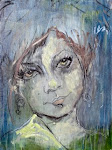
It's really easy for me to fall in love with materials. These past few years I've been dating acrylics. First, it was Tri-Art's gorgeous Artist Acrylic colours that won me over, then their innovative recycled paint Sludge...then I fell madly in love with Dry Media Ground, and now I just can't get enough of Nepheline Gels (the following artwork is graphite, charcoal and pastel on Nepheline Gel Coarse, and it's published in the New Acrylics Essential Sourcebook: Materials, Techniques, and Contemporary Applications for Today's Artist mixed media chapter). Just as I'm known for charcoal, acrylics have now become synonymous with my mixed media works, blurring the line between drawing and painting. Acrylic grounds allow me to create a textured surface that is very exciting and different than just working on common surfaces. And just like paper, I can soften dry media (graphite, charcoal, pastel) to a velvet finish with a brush, and also leave crisp edges, intense with colour or value.

Dry Media Ground is simply perfect, and will always be my true love! When you apply it to a surface, the result is like a very fine sandpaper. If you have ever used a pastel paper or board, that's what I'm talking about - it's the same thing, only it's much more cost effective to buy the Dry Media Ground in a jar and then you can create your own surfaces the way you want them. You can add colour to it or even apply it on top of layers of acrylic paint, creating a new surface of possibilities! On the other hand, Nepheline Gels have a unique granular texture and appearance. It's available in a fine (which is not as fine as dry media ground), a coarse and extra coarse. Just like Dry Media Ground, Nepheline Gel can be mixed with colour or used on it's own, glazed over top of and anything else you can think of....and it's a brilliant surface for graphite, charcoal, pastel and other drawing materials.

Gesso is a common ground for sealing surfaces for painting preparation. I love drawing on Gesso with graphite or charcoal. Gesso is a very dense White, but it is also avail in Black, Burnt Umber or Canvas colours, and even better, Tri-Art recently came out with a Clear Gesso and it's absolutely fabulous for tinting.  I also find it particularly useful when I have a beautiful piece of birch that I want to prepare and yet incorporate the natural wood surface into the art itself. I use to draw right onto wood and yet have found that over time the wood gets oily and stained and dirty, and I can already see that my newer pieces will last longer simply because the wood is primed. On that note, though I am an experimental art materials pixie, I've learned that there are some rules you should follow...there will always be plenty of rules you can still break! A few rules I recommend for all artists: always use good quality materials, take the time to experiment and get to know your materials, and prepare, finish and safely store your art. 


A few secrets to relieve any fear of acrylics and mixed media:
  • all acrylics and mediums are ok to mix. it's recommended to mix artist quality with artist quality/student quality with student quality and so on, but that aside don't hesitate to try new brands. Company's often has a signature colour or product, such as Tri-Art's new Artist Acrylic colour 'Golden Orange' and it's good to step out of your comfort zone even in regards to your favorite brand of paint!
  • acrylics are the most versatile medium out there, and can be used on a variety of surfaces and combined with any dry or water-soluble medium....and you can really open up new worlds by exploring collage and sculptural materials. 
  • Rheni Tauchid's book New Acrylics Essential Sourcebook: Materials, Techniques, and Contemporary Applications for Today's Artist will inspire and is a handy reference with detailed charts on how to prepare your surfaces, using acrylics with other mediums, media and materials.
  • it's ok to fall in love with your materials ...the paint, the canvas, the brushes, the tools... and the play, the journey, the creative process ♥

     
 MY FAVORITE QUOTE TODAY!
Creative people are curious, flexible, persistent and independent with a tremendous spirit of adventure and a love of play. ~Henri Matisse

Friday, February 12, 2010

Cityscape mixed media paintings

My cityscape series was in a group show last October, and recently featured on the Empty Easel Blog with a fabulous review. These works explore offbeat urban environments, created by abstracting the architectural and natural design elements of our beautiful and yet edgy cityscape.

From my love of drawing, I have developed a process of charcoal worked into layers of paint. I begin by drawing the basic and most important shapes, then layering dramatic values with minimal, harmonious colours. I draw into the paint with a charcoal stick, and use large Escoda Bristle brushes to blend the dry media to create rhythm in the line. I live for the final stages of adding textured and dark energetic marks.

Working with charcoal reminds how simple line is pure and beautiful, and some lines are so wonderful that instead of working with them, I work around them. It is an intuitive process working in harmony with the properties of the materials. There are beautiful collisions of media that become the forefront of my work and I hope it allows viewers to be curious and imaginative about the artistic process and result. 

Please visit my website to see the whole series, and for prices and availability.

Tuesday, December 1, 2009

December 2009 Feature Artist

Check out Occhuzzie Paint Company's website www.occhuzziepaintcompany.com (direct link here) to see my feature artist spot this month!


I discovered Occhuzzie earlier this year, and ordered 3 jars of their oil paint - Charcoal, Graphite and Zinc white (which was a free promo!). They are a small company that has stayed in touch with me, and Lance and Brandi were amazing and helpful in getting my order to me across the border. I havnt been using oils much this year, but got into the Charcoal and Zinc White oil paint on a recent self-portrait. The paint was smooth and very nice to use. I especially liked the jar it was in - I could use a palette knife to access and put back any unused paint. (no waste, love that!). I've started using the Graphite oil + Zinc White as a base, and I'm in love with the colour, cool, steel-blue! Both the Charcoal and the Graphite oil paints have a beautiful matte and dark translucent quality about them, and are great for toning colours. Occhuzzie's main point about the dry media pigment already being fused with oil, creating a more stable ground for underpainting makes a world of sense.  And it really makes sense for me personally, as I'm a mixed media artist whose always used charcoal worked into oil paint! So to end, I think both the Charcoal and Graphite oil paints by Occhuzzie are innovative and practical for both the modern and traditional artist.

Tuesday, November 10, 2009

Varnishing Mixed Media Art?

Most all of my work is mixed media containing charcoal and pastel. I know that even the best fixatives change colours and texture and softness, which is exactly what we love about them, and so I have learned through experimentation when and when not to apply a spray finish.


For example, I've been happy using Krylon's Crystal Clear for years as the most affordable and effective finishing spray for my work until I destroyed the luster on a piece that was primarily micaceous iron oxide and charcoal. I had to start over, and though I eventually got over the disappointment, for the first time I started questioning and thinking about why I was trying to 'varnish' mixed media work anyway.

When Rheni Tauchid's 2nd book, New Acrylics Essential Sourcebook came out, I thought about it even more after reading about mixed media and presentation in chapter 7 'Beyond the Basics'. It's a very good question for us artists that are exploring the outer limits of material combinations and yet it seems to me it may remain unsolved because there are too many variables and that maybe it's not about one golden answer...but rather knowing all your options.

I personally believe that if you are using quality materials, the discovery and collision of magic is all that matters. I have many beautiful pieces that are unvarnished and unframed because I've decided against it for one reason or another....but that said, I would love to know your thoughts about varnishing, finishing, fixing, protecting mixed media artwork that contains paint and drawing materials ie. charcoal on acrylics. Do you choose to varnish or not varnish? Any tips or product recommendations....

Here are some experimental and common sense methods that I know about, not including liquid 'brush-on' varnish such an acrylic polymer or top coat since I'm specifically interested in mixed media .
  1. frame the work behind glass
  2. use a matte or satin spray varnish, or Crystal Clear or Kamar Varnish. I used to use Grumbacher's Final Fixatif spray but it's now being sold as Prismacolor Tuffilm and is not as accessible to me. The downfall to all of the these products is they are permanent. I now recommend to spot varnish by masking off areas that are metallic, interference or glitter ect
  3. work the dry media into the paint or surface - this is a technique that creates a symbiotic superhero by combining materials while paint is still wet
  4. using a pastel fixative in between layers, leaving the last layer rich and soft (which is delicate, so I guess you should frame it!)
  5. using skim milk to fix charcoal and pastel on paper. Of course it will alter the work, so definitely an interesting approach for a particular effect (more on this technique here). ps. I am finding that I prefer wood panels and watercolour or printmaking paper to canvas these days.
  6. Sell your work in print format (cards, posters, giclee ect)
UPDATE - I recently used a spray varnish on a mixed media piece, and the spray varnish turned it white as if covered in snow! I researched quite awhile online and found that it's probably an old can and I didn't shake it enough. I shook the can for a few minutes then sprayed it again and it helped. I will only have to fix some areas instead of trashing the whole piece! *whew* I've thrown out the can and will be buying a new one.
    To end, I would LOVE to learn about your experiences and opinions on the matter. Leave a note and share discoveries!

    Rheni's blog - http://newacrylicsbooks.blogspot.com/
    New Acrylics Essential Sourcebook can be purchased at Amazon -a great addition to your library for all acrylic and mixed media artists!